The Quadrilateral Security Dialogue (QSD, also known as the Quad) is an informal strategic dialogue between the United States, Japan, Australia and India that is maintained by talks between member countries. The dialogue was initiated in 2007 by Prime Minister Shinzo Abe of Japan, with the support of Vice President Dick Cheney of the US, Prime Minister John Howard of Australia and Prime Minister Manmohan Singh of India.[1] The dialogue was paralleled by joint military exercises of an unprecedented scale, titled Exercise Malabar. The diplomatic and military arrangement was widely viewed as a response to increased Chinese economic and military power, and the Chinese government responded to the Quadrilateral dialogue by issuing formal diplomatic protests to its members.


The QSD ceased following the withdrawal of Australia during Kevin Rudd’s tenure as prime minister, reflecting ambivalence in Australian policy over the growing tension between the United States and China in the Asia-Pacific. Following Rudd's replacement by Julia Gillard in 2010, enhanced military cooperation between the United States and Australia was resumed, leading to the placement of US Marines near Darwin, Australia, overlooking the Timor Sea and Lombok Strait. India, Japan, and the United States continue to hold joint naval exercises through Malabar.
During the 2017 ASEAN Summits all four former members rejoined in negotiations to revive the quadrilateral alliance. In Manila, Prime Minister Malcolm Turnbull of Australia, Prime Minister Shinzo Abe of Japan, Prime Minister Narendra Modi of India, and President Donald Trump of the United States agreed to revive the security pact in order to confront China militarily and diplomatically in the South China Sea. A 2021 joint statement, "The Spirit of the Quad," emphasises the shared vision for a Free and Open Indo-Pacific, the rules-based maritime order in the East and South China Seas, and pledge to respond to the economic and health impacts of COVID-19.[2]
In March 2020, a first meeting of the Quad Plus was held, an expanded form of the existing Quad including representatives from New Zealand, South Korea and Vietnam, to discuss their respective approaches to the COVID-19 pandemic.[3][4]
In a joint statement, which became known as "The Spirit of the Quad", the leaders of the four nations declared their organising principle is:
...for the free and open Indo-Pacific. We strive for a region that is free, open, inclusive, healthy, anchored by democratic values, and unconstrained by coercion.[5]
Background
Strategic framework of US-China conflict
In the early twenty-first century, the strategic preoccupation of the United States with Iraq and Afghanistan served as a distraction from major power shifts in the Asia-Pacific, brought about by increased Chinese economic power, which undermined America's traditional role in the region.[6] In the long term the United States has sought a policy of "soft containment" of China by organizing strategic partnerships with democracies at its periphery.[6] While US alliances with Japan, Australia and India now form the bulwark of this policy, the development of closer US military ties to India has been a complex process since the collapse of the Soviet Union.
India-US military cooperation

Active US-Indian military cooperation expanded in 1991 following the economic liberalisation of India when American Lt. General Claude C. Kicklighter, then commander of the United States Army Pacific, proposed army-to-army cooperation.[7] This cooperation further expanded in the mid-1990s under an early Indian center-right coalition, and in 2001 India offered the United States military facilities within its territory for offensive operations in Afghanistan. US Defense Secretary Donald Rumsfeld and his Indian counterpart Pranab Mukherjee signed a "New Framework for India-US Defense" in 2005 under the Indian United Progressive Alliance government, increasing cooperation regarding military relations, defense industry and technology sharing, and the establishment of a "Framework on maritime security cooperation."[7] India and the United States conducted dozens of joint military exercises in the ensuing years before the development of a Quadrilateral dialogue, interpreted as an effort to "contain" China.[7] Indian political commentator Brahma Chellaney referred to the emerging Quadrilateral Security Dialogue between the United States, Japan, Australia and India as part of a new "Great Game" in Asia, and Indian diplomat M. K. Rasgotra has maintained that American efforts to shape security pacts in Asia will result not in an "Asian Century," but rather in an "American Century in Asia."[8]
Some, like US Lt. General Jeffrey B. Kohler, viewed US-India defense agreements as potentially lucrative for American defense industries and oversaw the subsequent sale of American military systems to India.[7] Nevertheless, some Indian commentators opposed increased American military cooperation with India, citing the American presence in Iraq, hostility to Iran and "attempts at encircling China" as fundamentally destabilizing to Asian peace, and objecting to the presence of American warships with nuclear capabilities off the coast of southern India, or to American calls for the permanent hosting of American naval vessels in Goa or Kochi.[8]
Trilateral Security Dialogue (TSD)
The Trilateral Strategic Dialogue (TSD) was a series of trilateral meetings between the United States, Japan, and Australia. The TSD originally convened at senior officials level in 2002, then was upgraded to ministerial level in 2005. The United States expected regional allies to help facilitate evolving US global strategy to fight against terrorism and nuclear proliferation. In return, Japan and Australia expected benefits including continued US strategic involvement and the maintenance of strategic guarantees in the region.[9]
2004 tsunami cooperation
In 2021, some commentators wrote that an ad-hoc Tsunami Core Group in response to the 2004 Indian Ocean earthquake and tsunami may have been an early precursor to the Quad.[10][11]
Creation and cessation of the Quad (2007-2008)
Creation
In early 2007, Prime Minister Abe proposed the Quadrilateral Security Dialogue, or "Quadrilateral Initiative", under which India would join a formal multilateral dialogue with Japan, the United States and Australia.[12][13]
The initiation of an American, Japanese, Australian and Indian defense arrangement, modeled on the concept of a Democratic Peace, was credited to Japanese Prime Minister Shinzo Abe.[14] The Quadrilateral was supposed to establish an "Asian Arc of Democracy," envisioned to ultimately include countries in Central Asia, Mongolia, the Korean peninsula, and other countries in Southeast Asia: "virtually all the countries on China’s periphery, except for China itself." This led some critics, such as former US State Department official Morton Abramowitz, to call the project "an anti-Chinese move,"[15] while others have called it a "democratic challenge" to the projected Chinese century, mounted by Asian powers in coordination with the United States. While China has traditionally favored the Shanghai Cooperation Organisation, the Quadrilateral was viewed as an "Asian NATO;" Daniel Twining of the German Marshall Fund of the United States has written that the arrangement "could lead to military conflict," or could instead "lay an enduring foundation for peace" if China becomes a democratic leader in Asia.[16]
China's opposition

China sent diplomatic protests to all four members of the Quadrilateral before any formal convention of its members.[17] In May 2007 in Manila, Australian Prime Minister John Howard participated with other members in the inaugural meeting of the Quadrilateral at Cheney's urging, one month after joint naval exercises near Tokyo by India, Japan and the United States. In September 2007 further naval exercises were held in the Bay of Bengal, including Australia.[14] These were followed in October by a further security agreement between Japan and India, ratified during a visit by Indian Prime Minister Manmohan Singh to Tokyo, to promote sea lane safety and defense collaboration; Japan had previously established such an agreement only with Australia.[14]
Though the Quadrilateral initiative of the Bush Administration improved relationships with New Delhi, it gave the impression of "encircling" China.[18] The security agreement between Japan and India furthermore made China conspicuous as absent on the list of Japan's strategic partners in Asia.[19] These moves appeared to "institutionally alienate" China, the Association of South-East Asian Nations (Asean), and promote a "Washington-centric" ring of alliances in Asia.[18][19]
The Japanese Prime Minister succeeding Abe, Taro Aso, downplayed the importance of China in the Japan-India pact signed following the creation of the Quadrilateral, stating, "There was mention of China – and we do not have any assumption of a third country as a target such as China." Indian Foreign Secretary Shiv Shankar Menon similarly argued that the defense agreement was long overdue because of Indian freight trade with Japan, and did not specifically target China.[20] On the cusp of visits to China and meetings with Prime Minister Wen Jiabao and President Hu Jintao in January 2008, the Indian prime minister, Manmohan Singh, declared that "India is not part of any so-called contain China effort," after being asked about the Quadrilateral.[21]
Australia's departure

Fears over Chinese military spending and missile capacities had helped drive Australia towards a defense agreement with the United States, as outlined by the 2007 Canberra Defense Blueprint; Sandy Gordon of the Australian Strategic Policy Institute had recommended the sale of uranium to India on the basis of similar considerations, as it appeared that the United States was backing it as a "counter to a rising China."[22] Chinese anger over the Quadrilateral however caused uneasiness within Australia even before the agreements were initiated.[23]
On becoming Prime Minister, Kevin Rudd visited China's foreign minister, Yang Jiechi, even before visiting Japan, and subsequently organised a meeting between Yang and the Australian foreign minister, Stephen Smith, in which Australia unilaterally announced it would "not be proposing" a second round of dialogue between the four partners.[24][25][26] Within Australia, this decision was seen as motivated by the uncertainty of China-United States relations and by the fact that Australia's principal economic partner, China, was not its principal strategic partner.[27] Rudd may furthermore have feared regional escalations in conflict and attempted to diffuse these via an "Asia-Pacific Union."[24]
Some US strategic thinkers criticized Rudd's decision to leave Quadrilateral; the former Asia director of the United States National Security Council, Mike Green, said that Rudd had withdrawn in an effort to please China, which had exerted substantial diplomatic effort to achieve that aim.[28] A December 2008 cable authored by US ambassador Robert McCallum and published by WikiLeaks reveals that Rudd did not consult the United States before leaving the Quadrilateral.[29]

US President Obama's efforts in November 2009 to improve US–Indian relations raised alarms in India and Australia both that a deepening military alliance between these powers could lead to regional escalations.[30] According to analyst John Lee, "For realists ... New Delhi has been warily balancing and competing against Beijing from the very moment of India's creation in 1947;" significant tensions between China and India were associated with the disputed Indian province of Arunachal Pradesh, and with Chinese nuclear weapons stationed on the Tibetan Plateau.[30] Rudd's calculation may have been that as a regional economic power, China was too important to contain through a simplistic Quadrilateral Initiative undertaken by US, India, Japan and Australia in 2007, when many regional powers are hedging their alliances in the event of a Japanese and an American decline.[30]
Intermission (2009-2017)
Continued cooperation on a bi- and trilateral level
In the years between the cessation and restart of the Quad, Quad members continued to cooperate on a bilateral or trilateral level, sometimes with non-Quad members involved.[31] This was especially the case in joint military exercises: Japan joined for the first time the Australian Kakadu and Nichi Trou Trident naval exercises in respectively 2008 and 2009, Japan and India held for the first time a joint naval exercise in 2012 and Australia and India did the same in 2015, Australia joined the US-Philippines Balikatan exercise for the first time in 2014 and Japan did the same in 2017, Japan joined for the first time the Indian Malabar exercise in 2015, and Japan joined for the first time the US-Australian joint naval exercise Talisman Saber in 2015.[31]
Shift in China's foreign policy
In 2013, Xi Jinping became leader of China. Since then, tensions between China and each of the four Quad countries have increased.[32] Xi has taken a hard-line on security issues as well as foreign affairs, projecting a more nationalistic and assertive China on the world stage than was the case with China's peaceful rise policy advanced by Xi's predecessor Hu Jintao.[33] Xi's political program calls for a China more united and confident of its own value system and political structure.[34]
Australia's shift in position

Rudd's replacement as Australian prime minister by Julia Gillard in June 2010 was associated with a shift in Australian foreign policy towards a closer relationship to the United States and a distancing from China.[35] The Australian, which has written extensively on the Quadrilateral and on Australian defense issues, argued after Rudd's replacement that "Australia's national interest is best served by continuing to engage and encourage our long-standing ally, the US, to retain its primacy in the region."[35] Despite Gillard's rapprochement with the US and increased US-Australian military cooperation, Rudd's decision to leave the Quadrilateral remained an object of criticism from Tony Abbott and the Liberal Party.[36]
Australia's decision not to sell uranium to India had weakened the Quad,[37] a move also criticized by the Liberal Party; the Party has however backed Gillard's support for a US military presence near Darwin, overlooking the Timor Sea and the Lombok Strait.[38] With support from the United States, Gillard and the Labor party have since reversed policy and backed the sale of uranium to India, which has refused to sign the Nuclear Non-proliferation Treaty.[39] On 5 September 2014, Australian Prime Minister Tony Abbott agreed to sell Uranium to India.
The US "Pivot to Asia"
The Obama administration's 2011 US "Pivot to Asia" represented a significant shift of resources and priorities in the foreign policy of the United States away from the Middle Eastern/European sphere and the US began to invest heavily in East Asian countries, some of which are in close proximity to the People's Republic of China.[40] The pivot also included taking the lead in the Trans-Pacific Partnership trade agreement, and rejecting the Chinese claims on the islands in the South China Sea.[32] The US policy shift towards East-China was generally seen as a move to oppose the growing influence of China in the region.[32]
Japan's diplomacy towards a Free and Open Indo-Pacific
Japan opened a naval base in Djibouti in 2011, its first long term naval base overseas, and part of its growing involvement in the wider Indo-Pacific region.[31] In December 2012, Shinzo Abe had prepared a proposal on strategic framework "Asia’s Democratic Security Diamond", a sort of Quad remake, to be published from an international media organization before his second administration in Japan, and it was published on the next day of his prime minister designate.[41] The Japanese government had worked to clarify the concepts in Prime Minister Abe's proposal of 2012, implemented in diplomatic statements, and prepared the official announcement of "Free and Open Indo-Pacific" in 2016.
India's shift in position
In the years following the cessation of the Quad, India was not keen to reinstate the grouping, out of fear it would antagonize China.[42] After several years of growing tensions with China on a range of topics, and particularly after the 2017 border standoff, India started to express renewed interest.[42][43]
Restarting the Quad (2017-)
Restarting the Quad
In November 2017, American president-elect Donald Trump visited Japan and agreed with Prime Minister Abe to pursue Japan's "Free and Open Indo-Pacific" strategy.[44]
The visit coincided with a meeting by Japanese, Indian, Australian and American officials to continue military cooperation ahead of the ASEAN and East Asia Summits in November 2017.[45] The meeting included discussion of China's increased prominence in the South China Sea, and may have signaled U.S. president Trump's interest in reviving a formal Quadrilateral.[46][47]
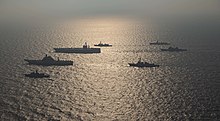
The Quadrilateral met five times in 2017–2019.[48] During the Raisina Dialogue in New Delhi in 2018, the navy chiefs of Japan, US, Australia and India came together, one of the first indications of the revival of the Quad's security structure.[49]
In 2019, four ministers met in New York City to discuss reforming the Quad,[54] and then again in Bangkok.[55] The next summer, India, Japan and US invited Australia to the co-ordinated navy exercise at Malabar; the exercises were delayed due to the Coronavirus Pandemic.[56]
In March 2020, instigated by the US, the Quad members held the first meeting of the Quad Plus, an expanded form of the existing Quad including representatives from New Zealand, South Korea and Vietnam, it bringing key Indo-Pacific states together to discuss their respective approaches to the COVID-19 pandemic.[3]
Following the 2020 Malabar naval exercises, American secretary of state and former CIA director Mike Pompeo met with members of the quad to discuss converting the security arrangement into an "Asian NATO" with "shared security and geopolitical goals."[60] One commentator at the South China Morning Post described the concept as "a bulwark against the rise of China," and a Chinese diplomat protested the concept as an attempt to "wind back the clock of history:"[66]
The foreign secretary of Sri Lanka raised concerns in October 2020 about the militarization of the Quad in the Indian Ocean.[67] At the same time, Japan, the US and Canada held a joint naval exercise called Keen Sword in October, one of several Canadian naval exercises in the Taiwan straits that year, and accompanied by diplomatic meetings in Tokyo.[73] though no joint statement was produced from the meeting.[74] With a meeting by Australian Prime Minister Scott Morrison to Tokyo, Australia and Japan agreed in principle to defense pact that will increase military ties.[75][76]
On 3 March 2021, The White House, now under president Biden, issued the "Interim National Security Strategic Guidance",[77] and two days later, Australian Prime Minister Morrison told that the leaders of the Quad will hold their first-ever meeting virtually. Morrison said he had discussed arrangements with US President Joe Biden and Vice President Kamala Harris in recent weeks.[78] And in the next week, on 12 March, the first summit meeting was held virtually by the leadership of US President Biden.[82] Commitment of the Quad will be implemented by the launch of a senior-level Quad Vaccine Experts Group, The Quad Climate Working Group and The Quad Critical and Emerging Technology Working Group.[83] It had been reported before the summit meeting that the four countries are working to develop a plan to distribute COVID-19 vaccines to countries in Asia as part of a broader strategy to counter China's influence,[84] and that India had urged the other three countries to invest in its vaccine production capacity.[85] The next summit meeting will be held in-person by the end of 2021.[2] In March 2021, the Quad pledged to respond to the economic and health impacts of COVID-19.[2]
On 15 March, US Secretary of State Antony Blinken and Defense Secretary Lloyd Austin arrived at the Yokota Air Base in Tokyo.[86] They had contributed an article before their flight.[87] On 16 March, the two US officials participated in a Security Consultative Committee (SCC), the so-called "two-plus-two", with Japanese Foreign Minister Motegi and Defense Minister Nobuo Kishi. Also, the two US officials have met and talked with Prime Minister Suga.[88][89][90]
On 19 March, US Defense Secretary Austin arrived at India, and met with Prime Minister Shri Narendra Modi.[91] and Indian National Security Adviser Ajit Doval. On the next day, he discussed with Indian Defense Minister Rajnath Singh.[92][93]
Upcoming events
US President Biden and Japanese Prime Minister Suga will meet on 16 April in Washington, D.C. According to Japanese cabinet secretary Katsunobu Kato, the meeting will affirm cooperation on issues including efforts to contain COVID-19 and climate change. The meeting will likely be a venue for both Japan and the US to call for North Korea to abandon its nuclear weapons program, and for the US to support Japanese claims to the disputed Senkaku islands.[94] Suga plans to visit India and the Philippines[95] after his foreign and defense ministers are meeting with Germany mid-April.[96] He will seek to reaffirm its cooperation towards a Free and Open Indo-Pacific region, following China's increased maritime assertiveness.[97] With India and the US, he is also seeking to further solidify the Quad framework.
Japan and India will hold a "two-plus-two" foreign and defense ministerial meeting in Tokyo in late April, government sources said. The ministers are expected to agree on strengthened cooperation to realize "Free and Open Indo-Pacific".[98]
Collaborating with allies
At the Shangri-La Dialogue in Singapore in June 2018, French and British defense ministers announced they would sail warships through the South China Sea to challenge China's military expansion.[99] In a similar move, on 16 September 2020, France, the UK and Germany together submitted a note verbale to the United Nations, which reaffirmed that the integrity of UNCLOS needs to be maintained, stating that China's territorial claims in the South China Sea do not comply with it.[100]
On 20 January 2021, Joe Biden became the president of the United States, and two days later, US and Japanese top security officials discussed security issues.[101] Three days after that, the Japanese Foreign Minister, Toshimitsu Motegi, attended the EU Foreign Affairs Council to promote cooperation between Japan and the EU to realize "Free and Open Indo-Pacific (FOIP)".[102][103] On 18 February, during the third ministerial meeting,[104][105][106][107] the United States, Australia, Japan and India agreed to strongly oppose any use of force by China,[108] and vowed to work with ASEAN and Europe to meet their aims.[109][110]
Canada
While Canada hasn't published an Indo-Pacific strategy yet, it started increasing its naval presence in the region in 2020. In June 2020, Canadian frigate HMCS Regina and auxiliary vessel MV Asterix sailed through the Taiwan Strait.[111] In January 2021, HMCS Winnipeg did the same and later joined the navies of the Quad members in the naval exercise Sea Dragon, according to a Canadian official "to demonstrate the strength and durability of our alliances in the Indo-Pacific region".[112][113] In late March, the Canadian frigate HMCS Calgary passed near the Spratly Islands, which China claims.[114]
European Union
The first Quad summit, held in March 2021, explored a partnership with Europe. France, Germany, and the Netherlands have announced their Indo-Pacific visions, and the EU is in the midst of formulating its own.[115]
France
In June 2018, the same month as the 2018 Shangri-La Dialogue, France, with 1.6 million of its citizens living and over 90% of its Exclusive Economic Zone located in the Indo-Pacific region, was the first EU member to publish an Indo-Pacific strategy, following increased Chinese assertiveness in the region.[116] It was also the first EU member to use the geopolitical concept of the Indo-Pacific. Partnerships with all four members of the Quad as well as with ASEAN are a key component of France's Indo-Pacific strategy.[117] It updated the policy document in May 2019. Also in 2018, the French frigate Vendemiaire sailed through the Taiwan Strait.[118]
On 9 September 2020, France, India and Australia held their first India-France-Australia Trilateral Dialogue, with their foreign secretaries meeting through videoconference.[119] In December 2020, France also revealed it will join for the first time the joint military drills with Japan and the US in May 2021.[120] On 10 February 2021, the French submarine Emeraude patrolled through the South China Sea, proving its capacity to deploy over long distances and work together with the navies of Australia, the US, and Japan.[121] On 24 February 2021, a second India-France-Australia Trilateral Dialogue meeting was held, to evaluate progress on the actions defined in the first trilateral meeting in September.[122][123] On 30 March 2021, French Navy’s amphibious assault helicopter carrier Tonnerre and escort frigate Surcouf arrived at the Kochi port in Kerala, India, ahead of a joint naval exercise with the four Quad member countries.[124] The French naval drill exercise is called La Perouse and is scheduled to take place from 5 to 7 April 2021. South China Morning Post reported this as the first instance of naval exercises to involve all four Quad members.[125] Late April, India and France are holding their separate annual Varuna naval exercise.[126] The two French warships are on a five-month-long deployment in the Indo-Pacific. On 13 April 2021, a third India-France-Australia Trilateral Dialogue meeting is planned, which will take place in New Delhi.[127]
Germany
On September 1, 2020, the German government followed, releasing a policy document in which the country for the first time officially endorsed the concept of the Indo-Pacific, and amongst others includes actively building partnerships in the region, including on security matters, calling on the EU to do the same.[128] In December 2020, in an online meeting between Japan's and Germany's defense ministers, Japan expressed hopes for Germany to send a warship to the Indo-Pacific region, and join drills with Japan Self-Defense Forces,[129] In March 2021, Germany confirmed that it will send in August a frigate to the South China Sea,[130] making it the first German warship since 2002 to traverse this region.[131] In mid-April 2021, the foreign and defense ministers of Japan and Germany are meeting via videoconference to discuss Indo-Pacific security topics.[132]
The Netherlands
In November 2020, the Netherlands published its Indo-Pacific strategy, making it the third EU member to do so, following similar moves by France and Germany.[133] The policy document calls on the EU to build partnerships in the region and to reject Chinese territorial claims more strongly. As part of this policy shift, the Netherlands will send the frigate HNLMS Evertsen to the Indo-Pacific as part of the British aircraft carrier group later this year.[134] In April 2021, Dutch prime minister Rutte and Indian prime minister Modi held a videoconference meeting to discuss cooperation in the Indo-Pacific region.[135]
The UK
In December 2020, the UK announced it would dispatch an aircraft carrier strike group to waters near Japan as soon as early 2021, planning to conduct joint exercises with US military and Japan Self-Defense Forces in May.[136][137][138] The strike group will consist of: the carrier HMS Queen Elizabeth (R08) with an embarked air group (consisting of 24 F-35 aircraft from No. 617 Squadron RAF and Marine Fighter Attack Squadron 211, along with 9 Merlin helicopters and a number of Wildcat helicopters); two Type 45 destroyers; two Type 23 frigates; two Royal Fleet Auxiliary logistics vessels; an Astute-class submarine; the American destroyer USS The Sullivans, and the Dutch frigate HNLMS Evertsen.[139][140][141][142] Once it has set sail, the strike group will also be joined by "at least a frigate" of the Royal Australian Navy,[141] and a number of vessels from the Japan Maritime Self-Defense Force,[143] before it is reported that it will enter the South China Sea.[144]
In March 2021, the UK published a policy document titled the "Integrated Review" which confirmed the UK's foreign policy shift towards the Info-Pacific and included a nine-step plan detailing what this shift entails.[145] The document acknowledged that trade between the UK and China was mutually beneficial, yet it also named China as "the biggest state-based threat to the U.K.’s economic security" and called on middle powers to work together in this new geopolitical context.[145]
Concept of the Indo-Pacific
The four Quad members have played a major role in purposefully redefining the "Asia-Pacific" as the "Indo-Pacific", to recognize and to deepen trans-regional ties between the Indian and Pacific Ocean areas, and to deal more effectively with rise of China, the Middle East and Africa.[3] The term gained traction in the political lexicon and strategic thinking of not only the Quad members, but since recently also of ASEAN[146], the European Union, France[147], Germany[148], the Netherlands,[149] and the UK.[145]
Analysis
According to the American think tank Center for a New American Security, CNAS, the United States pursued a Quadrilateral Security Dialogue in an effort to adapt to an increasingly economically powerful China in the Asia-Pacific, where great power rivalry, massive military investment, social inequality, and contemporary territorial disputes have all made war in Asia "plausible."[6] According to the CNAS, establishing a series of alliances among nations recognized as democratic by the United States furthers its own interests: "It is precisely because of the rise of Chinese power and the longer term trend towards multipolarity in the international system that values can and should serve as a tool of American statecraft today."[6]
Prominent U.S. politicians from both Democratic and Republican parties have advocated a more aggressive diplomacy in Asia. During the 2008 US presidential campaign, President Obama called for a new worldwide concert of democracies to counter the influence of Russia and China in the UN Security Council; key officials of Obama's administration were involved in the Princeton Project, whose final report called for the construction of a new ‘concert of democracies.’[150] Secretary of State Hillary Clinton’s Policy Planning Director at the State Department, Anne-Marie Slaughter, authored the Princeton Project’s final report, which "called for reconstituting the quadrilateral military partnership among the United States, Japan, Australia and India." John McCain also called for a "league of democracies," and Rudy Giuliani for incorporating Asia's militarily capable democracies into NATO.[150] The development of the Quadrilateral Security Dialogue took place in the context of Chinese military modernization, geared towards contingency in Taiwan Strait but also towards "force projection capabilities." Some US officials view Chinese assertiveness in South China Sea as demonstrated by the naval confrontation between the USNS Impeccable and Chinese naval vessels near Hainan Island.
| This article uses material from the Wikipedia article Metasyntactic variable, which is released under the Creative Commons Attribution-ShareAlike 3.0 Unported License. |